 EN
EN

20-Bit 1.8 MSPS ADC CM2431 vs. AD4020: Dual Assurance of High Performance and Ease of Use
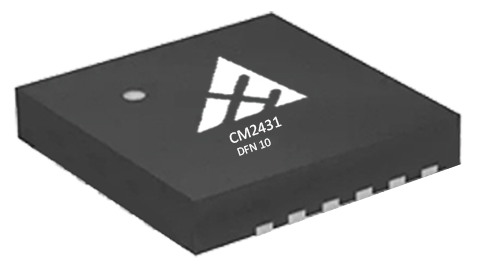
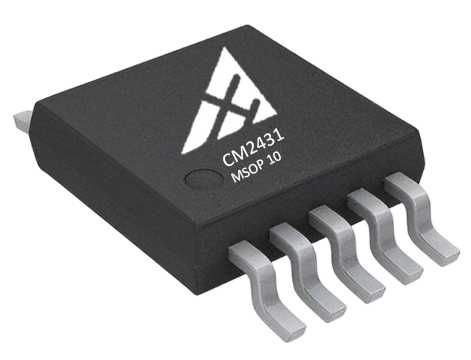
In high-end application areas such as industrial sensing, precision instrumentation, and medical equipment, data acquisition systems face extremely stringent performance requirements. High-precision SAR ADCs play a central role in these systems. Beyond ultimate performance and long-term reliability, an ADC that is thoughtfully designed for ease of use—based on the customer’s design experience—offers stronger overall competitiveness.
The CM2431 is a 20-bit SAR ADC with a sampling rate of up to 1.8 MSPS. Compared with the international competitor AD4020, the CM2431 delivers benchmark-level signal-to-noise ratio and wide-temperature reliability, while also achieving excellent linearity, with integral nonlinearity as low as ±1.5 ppm. In addition, it provides a wider dynamic range and more efficient power consumption.
Unlike traditional SAR ADCs, the CM2431 integrates multiple ease-of-use features that provide greater design flexibility, address application challenges, and help users achieve higher system performance while simplifying designs and reducing cost and power consumption.
1. Ease-of-Use Features Enable Simplified Design
Pre-Input Driver Simplifies System Integration
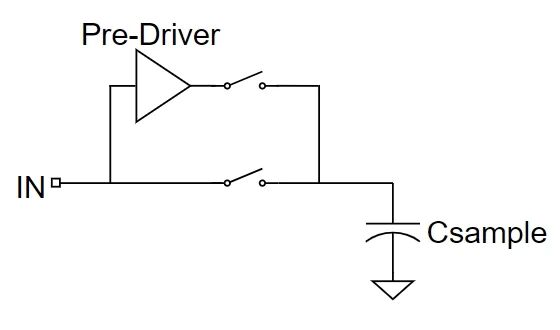
The CM2431 adopts a Pre- Input Driver technology that reduces signal kickback caused by the internal switched-capacitor architecture at the start of sampling, making the ADC significantly easier to drive and fundamentally simplifying system design. Figure 2 illustrates the variation of the CM2431’s analog input current versus differential input voltage with the pre-charge input driver enabled and disabled. Even when disabled, the CM2431’s low input current already makes it easier to drive than traditional SAR ADCs. When enabled, the analog input current is reduced to the sub-microampere level, enabling superior drive performance. This technology has been filed for invention patent protection.
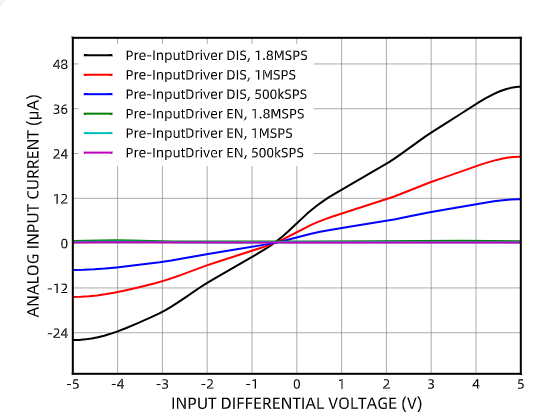
Simulate input current differential with input
With the Pre-Charge Input Driver enabled, users can directly drive the ADC using low-power, low-bandwidth precision amplifiers combined with lower RC filter cutoff frequencies, without the need for expensive dedicated high-speed ADC drivers. This simplifies the peripheral circuit design. In precision, low-bandwidth applications, this approach significantly reduces system power consumption, size, and overall cost.
Key benefits include:
Reduced front-end complexity and significantly lower performance requirements for external driver circuits;
Lower BOM cost, reduced PCB area, and simplified component selection and design;
Lower power consumption and higher integration for system-level solutions.
In addition, the Pre-Charge Input Driver allows the front-end amplifier and RC filter to be selected based on the signal bandwidth of interest, rather than being constrained by the settling-time requirements of switched-capacitor SAR ADC inputs. It also improves THD performance and reduces analog input current for input signals below 100 kHz.
Clamp Protection Circuit Simplifies Driver Design
Integrated overvoltage clamp diodes and a range-compression mode further reduce the difficulty of front-end driver design. In the past, to achieve good driving performance, ADC drivers often required an additional negative supply voltage. At the same time, the positive supply rail of the driver amplifier often exceeded the voltage limits of the SAR ADC, requiring extra protection circuitry. The CM2431 features clamp protection extending 0.4 V beyond VREF, and its range-compression mode eliminates the need for a negative supply while maintaining the input range. These features significantly simplify driver design.
In addition, digital interface design and driver debugging for high-speed, high-resolution products have long been design challenges. The CM2431’s Turbo mode extends the data transfer time for conversion results, allowing the use of lower SPI clock frequencies.
2. Superior Dynamic Range for Accurate Capture of Weak Signals
The CM2431 offers a high dynamic range of 102 dB, enabling fine discrimination of weak signal differences. In applications with extremely demanding data acquisition requirements—such as signal processing, medical imaging, scientific measurement, and communications—this capability provides a clear advantage. A higher dynamic range means that signal integrity can be maintained even in complex noise environments, providing a more reliable data foundation for the system.
At the same time, the CM2431’s sampling rate of up to 1.8 MSPS allows precise capture of high-frequency signals and supports oversampling. Its excellent linearity (typical INL within ±2 LSB) ensures that the system can achieve extremely high dynamic range after oversampling. For example, with 1024× oversampling, the dynamic range can be increased to approximately 131 dB, enabling the system to capture both extremely weak and strong signals simultaneously—achieving “no distortion of weak signals” and “no saturation of large-amplitude signals.” This technique is a core method in high-precision data acquisition systems and is widely used in applications with extremely stringent SNR requirements.
3. Excellent Energy Efficiency for Improved Battery Life and Thermal Optimization
While maintaining high performance, the CM2431 reduces power consumption by approximately 15% compared with the competing AD4020. In high-precision continuous acquisition systems, the cumulative energy savings are significant and can be directly translated into longer device battery life, reduced thermal design pressure, and improved overall system reliability.
Conclusion
In summary, with its 20-bit resolution and 1.8 MSPS sampling rate, the CM2431 delivers high performance combined with system-level simplification enabled by Pre-Charge Input Driver technology, excellent linearity, superior dynamic range, and improved overall energy efficiency. It provides a highly competitive solution for high-precision data acquisition systems.
With a simplified design and greater integration convenience, the CM2431 helps users reduce power consumption and system design complexity, increase channel density, and maintain excellent overall system performance.